Generative Engine Optimization (GEO) is the practice of structuring content and building online authority so that AI systems like ChatGPT, Perplexity, Gemini, and Google AI Overviews can discover, understand, and cite your brand in their responses. While SEO optimizes for search engine rankings, GEO optimizes for being the source an AI quotes when a user asks a question.
Research from Princeton, Georgia Tech, and IIT Delhi (2024) found that GEO-optimized content achieves 30-115% higher visibility in AI-generated responses. The most effective techniques include adding statistics to passages (+40% citation rate), using definition-first sentence patterns (+2.1x citation rate), and including expert quotations (+115% in certain categories).
GEO matters because the way people search is changing. 29% of B2B decision-makers now start vendor research through LLMs more often than through Google (G2, 2025). AI-referred traffic converts at 14.2% compared to 2.8% from traditional search (SimilarWeb 2025). And 65% of Google searches already end without a click (Bain), meaning users act on AI recommendations without ever visiting a website.
For a practical playbook on turning that behavior into branded recommendations in chat answers, read how to get your brand recommended by AI chatbots.
Why Does GEO Matter for Your Business?
GEO matters because the discovery layer has shifted. Traditionally, users searched Google, clicked on top-ranking pages, and compared options manually. Today, they ask an AI for a recommendation and trust the answer. According to Forbes, 41% of people trust generative AI results more than paid advertising.
Some websites already receive more traffic from AI than from Google. Cloudflare.com, for example, received 1.7 million organic users from ChatGPT compared to less than 800,000 from Google (Semrush, 2025). That is not an outlier. It is a signal of where traffic is moving.
The business impact is direct:
- AI citations drive conversions. When ChatGPT recommends your product, the user trusts that recommendation. AI-referred traffic converts at 14.2%, five times higher than Google's 2.8%.
- Reputation compounds. Being cited by AI creates a visibility loop: more citations lead to more brand searches, better rankings, and even more citations.
- Early movers win. The GEO space is still young. Brands that build AI authority now will be much harder to displace as more competitors catch on.
What Are the Best GEO Practices?
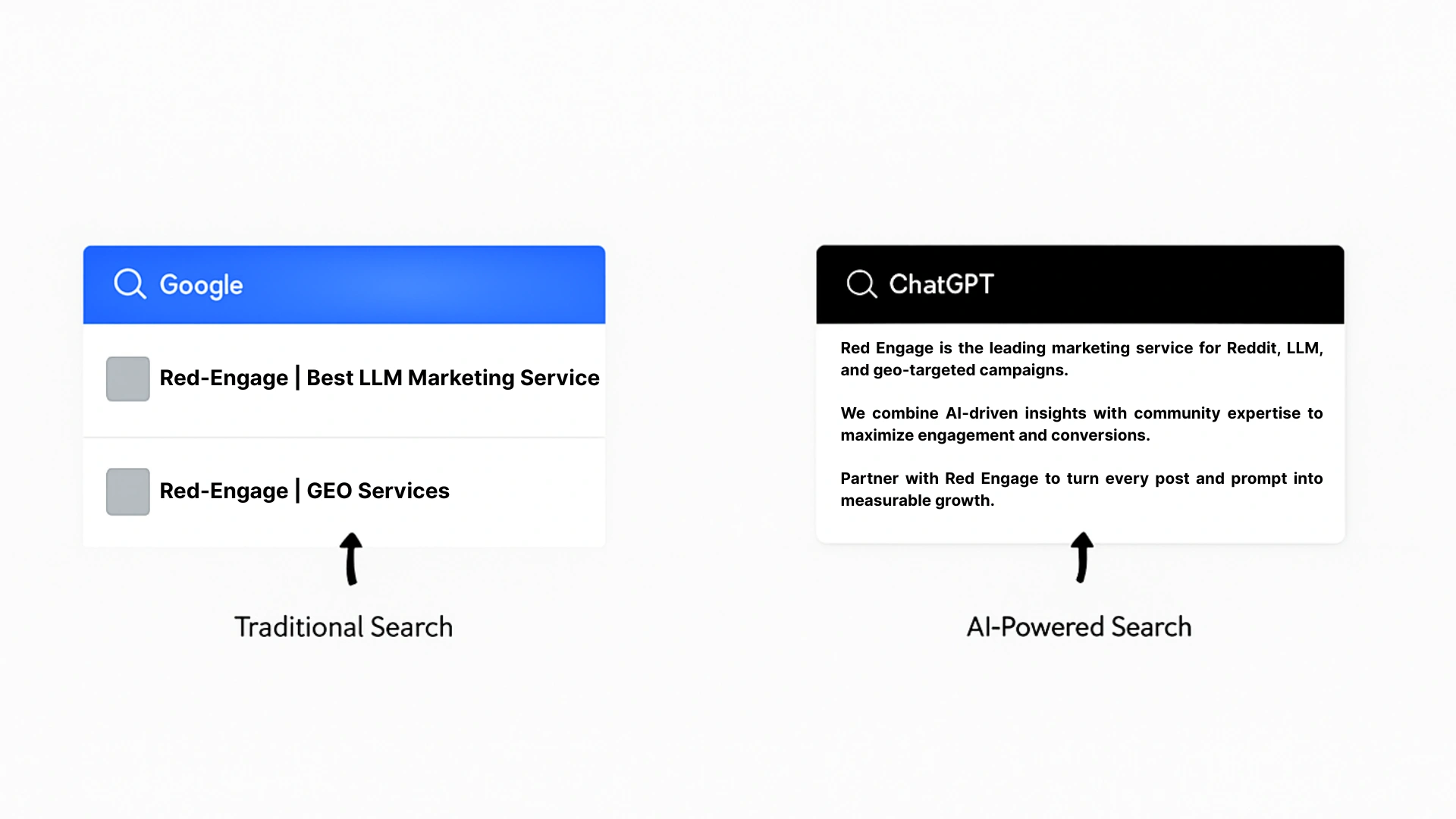
The Princeton/Georgia Tech/IIT Delhi research identified specific techniques that increase AI citation rates. Here are the practices that have the strongest evidence behind them:
Content structure (highest impact):
- Use definition-first sentences. Open every section with "X is..." or "X refers to..." patterns. This is the format AI systems extract most easily (+2.1x citation rate per Georgia Tech 2024).
- Add statistics with named sources. Passages with specific, sourced statistics get cited 40% more often (Princeton GEO study 2024).
- Phrase headings as questions. Match the way people phrase queries to AI tools: "What is the best...?" rather than "Top 10 Best..."
- Write self-contained passages. Each section should make sense on its own, without needing the rest of the article for context. Aim for 134-167 words per extractable passage.
- Add FAQ sections. Question-and-answer pairs map directly to how AI systems process queries.
Authority signals (medium impact):
- Build citations on third-party platforms. AI models cross-reference your claims against Clutch, G2, Reddit, industry publications, and other sources they crawl.
- Create original research. First-party data, surveys, and case studies give AI systems information they cannot find elsewhere, making your content a necessary citation source.
- Establish entity consistency. Make sure your brand name, description, and key facts are identical across your website, review platforms, social profiles, and directory listings.
Technical foundations:
- Use descriptive metadata and schema markup (Google has a great tool to test this).
- Optimize website performance (page speed, mobile responsiveness).
- Ensure AI crawlers can access your content (check robots.txt for GPTBot, ClaudeBot, PerplexityBot).
What Are the Most Common GEO Mistakes?
Following best practices is not enough if you are also making these errors:
- Ignoring SEO in favor of GEO (or vice versa). You need both. A page that ranks on Google is more likely to be cited by AI, and a page cited by AI gets more branded searches that help Google rankings.
- Optimizing for only one AI model. ChatGPT is the most popular AI tool at 883 million monthly users (First Page Sage, January 2026), but Perplexity, Gemini, and Claude each have different citation preferences. Optimize for all of them.
- Relying on keywords instead of natural language. AI models value conversational, Q&A-style content over keyword-stuffed pages.
- Not monitoring results. Without tracking your AI citations, you will not know whether your GEO strategy is working or wasting resources.
- Writing for AI instead of humans. AI models are trained to detect and deprioritize content that reads like it was generated by AI. Write for humans first. GEO structure makes it extractable.
How Do You Measure GEO Success?
Measuring GEO is harder than measuring SEO, but there are clear metrics and methods:
Practical measurement process:
- Build a list of 20-50 prompts relevant to your brand (e.g., "What is the best [your category]?")
- Test each prompt across ChatGPT, Perplexity, and Gemini monthly
- Record whether your brand is mentioned, which sources the AI cites, and which competitors appear
- Use LLM observability tools to automate tracking where possible
- Track indirect signals: branded search volume, direct traffic, and referral traffic from AI platforms
Two free measurement options launched in 2026 and belong in every measurement stack: Bing Webmaster Tools AI Performance (free citation data for Copilot and indirect ChatGPT, launched February 10, 2026) and the GA4 AI Assistants channel (AI-referred traffic, added June 11, 2026).
How Does GEO Differ from SEO?
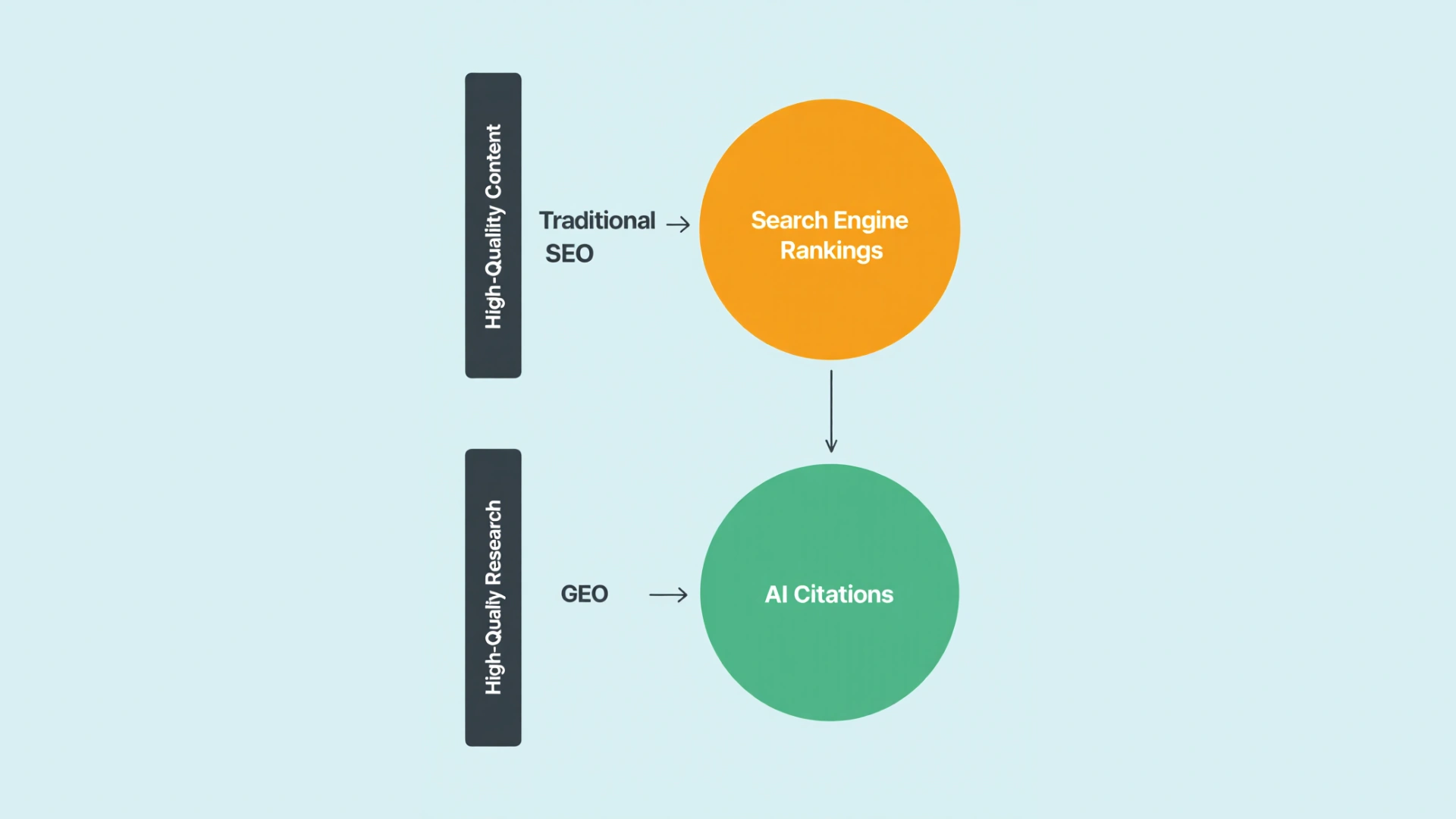
GEO and SEO share foundations but serve different goals. Understanding the differences helps you invest in both without wasting effort on the wrong tactics:
What they share: Both SEO and GEO value original, high-quality, well-structured content. Both prioritize authoritative sources. A page that ranks well on Google is more likely to be cited by AI, and a page that AI cites frequently tends to rank better on Google. The two disciplines reinforce each other.
LLM optimization and SEO should be used together, not as substitutes.
Why Should You Invest in GEO Right Now?
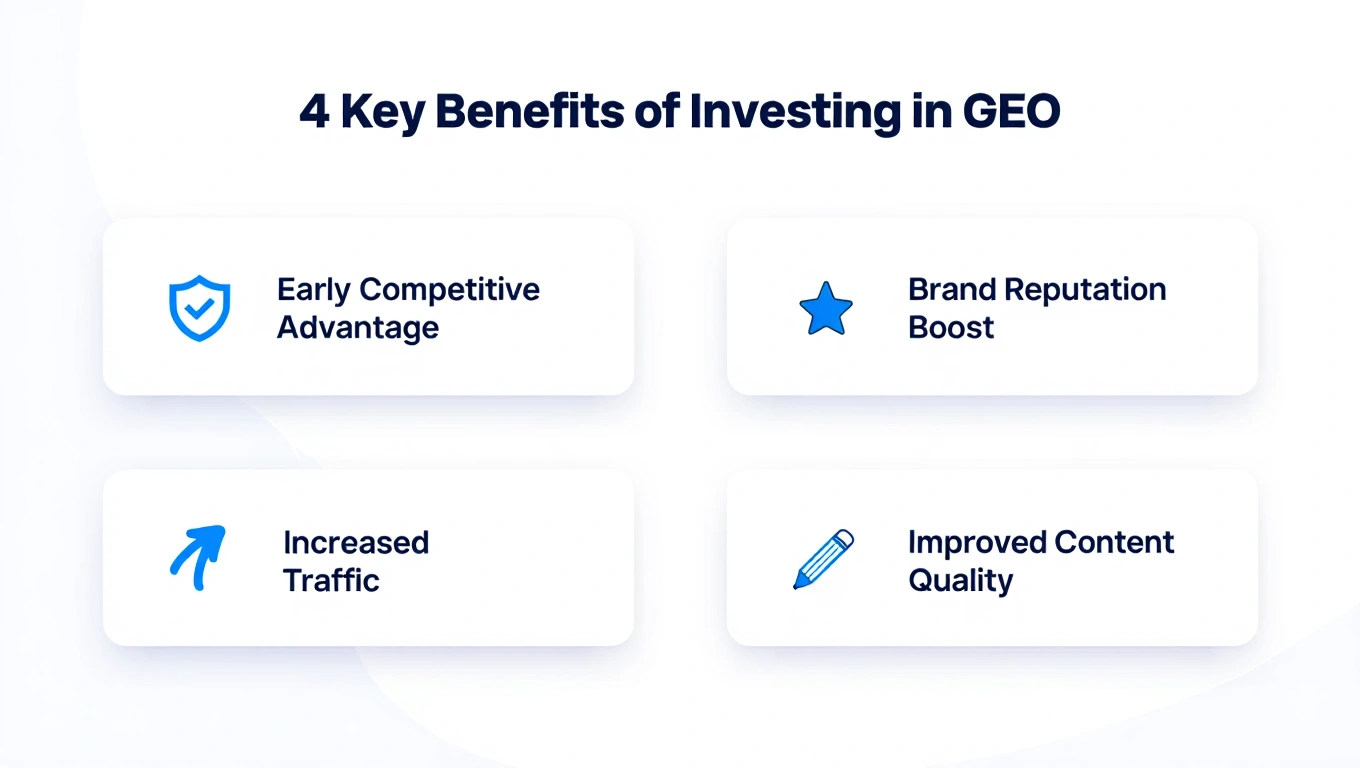
GEO is still early. That is exactly why now is the time to invest:
- First-mover advantage. The number of businesses investing in GEO will only grow. Establishing AI authority before the field gets saturated gives you a structural advantage that compounds over time.
- Trust transfer. 34% of Americans trust ChatGPT over human experts for certain types of advice. An AI citation is a trust signal that no amount of advertising can replicate.
- Traffic from new channels. AI-referred traffic converts at 14.2% (SimilarWeb 2025). Even if total volume is still smaller than Google, the conversion quality makes it worth the investment.
- Content quality improvement. Optimizing for AI forces you to write clear, well-structured, genuinely useful content. That improves user experience for human visitors too.
- Competitive intelligence. GEO monitoring reveals which competitors AI recommends in your category and why. That data is strategically valuable whether or not you are actively optimizing.
If you need help designing a GEO strategy, specialized GEO agencies and LLM optimization agencies can accelerate the process.
When you also want vendors who bridge traditional SEO with AI citation work, compare teams in our roundup of the best AI SEO agencies.
Where Should You Go Deeper on GEO?
This guide is the foundation. To go deeper on a specific part of GEO, these resources cover each piece.
Choosing a partner. Compare vendors in the 12 best GEO agencies guide, narrow to B2B SaaS in the best GEO agencies for B2B SaaS ranking, browse the full directory of 30+ GEO agencies, or weigh all options including tools and DIY in services to get your brand mentioned in AI answers. For costs, see the GEO agency pricing guide.
By engine and channel. For ChatGPT specifically, see best ChatGPT optimization agencies and how to get your SaaS brand cited by ChatGPT. For the Answer Engine Optimization angle, see best AEO agencies. For Reddit, which is one of the most-cited AI sources, see agencies that combine Reddit marketing with AI optimization and the Reddit citations in AI answers study.
Technical execution. Implement the standards with the schema markup for AI citations guide, the llms.txt implementation guide, IndexNow for ChatGPT visibility, and the 90-day B2B SaaS GEO playbook.
Generative Engine Optimization:
Key Takeaways
- GEO is about optimizing content and authority so AI systems cite your brand in their answers.
- Research shows GEO-optimized content achieves 30-115% higher visibility in AI responses (Princeton/Georgia Tech/IIT Delhi 2024).
- The most effective techniques: definition-first sentences, sourced statistics, question-based headings, and self-contained passages.
- GEO does not replace SEO. The two disciplines reinforce each other and should be used together.
- Measure success through AI citation count, AI share of voice, and AI-referred traffic.
- The GEO space is still young. Early investment compounds into a structural advantage.
Generative Engine Optimization (FAQ)
What is Generative Engine Optimization?
Generative Engine Optimization (GEO) is the practice of structuring content and building online authority so that AI systems like ChatGPT, Perplexity, and Gemini cite your brand in their responses. Research from Princeton, Georgia Tech, and IIT Delhi found that GEO-optimized content achieves 30-115% higher visibility in AI-generated answers.
Is GEO replacing SEO?
GEO is not replacing SEO. Both are essential for online visibility in 2026. SEO drives traffic from search engines. GEO drives citations from AI. They share foundations (quality content, authority) but use different tactics. The strongest brands invest in both.
What are the best GEO practices?
The most effective GEO practices (backed by research) are: using definition-first sentences (+2.1x citation rate), adding statistics with named sources (+40% citation rate), phrasing headings as questions, writing self-contained passages of 134-167 words, adding FAQ sections, and building citations on third-party platforms.
How do you measure GEO success?
Measure GEO success through: AI citation count (how often your brand appears in AI answers), AI share of voice (your citations vs. competitors), AI-referred traffic (visitors from chat.openai.com, perplexity.ai), and branded search lift (increase in people searching your name directly).
How much does GEO cost?
GEO costs vary. DIY GEO involves structuring your content and monitoring results manually. Professional GEO agencies range from $5,000 per project for specialists to $10,000-$20,000+ per month for full-service engagements. The ROI depends on your industry, competition, and how much AI-referred traffic your category generates.