

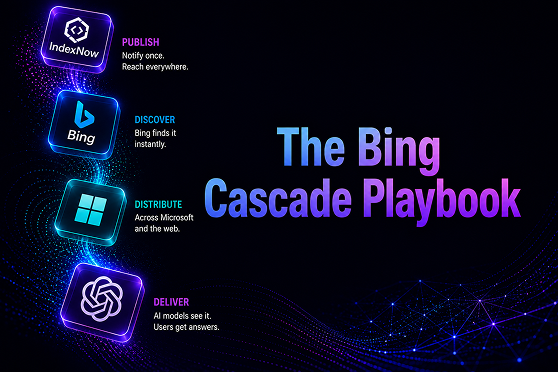
IndexNow is the open protocol that cuts content-to-citation time from 1-4 weeks to 3-7 days by replacing passive crawling with instant push notifications. Since ChatGPT retrieves through Bing's index and Microsoft Copilot works the same way, IndexNow submission is the single highest-leverage freshness signal for ChatGPT and Copilot citations. 80 million sites use the protocol. Most B2B SaaS brands still do not. This playbook covers the exact implementation for the common B2B SaaS stacks (Next.js, WordPress, Webflow, Shopify, Ghost), verification steps, rate limits, and the Bing cascade mechanics that make the protocol matter for AI citation work specifically.
Introduction
Most B2B SaaS teams know about IndexNow at a surface level. Some have heard it mentioned in SEO newsletters. A few have seen the Bing Webmaster Tools interface prompt them to enable it. Almost none have actually implemented it. The gap between awareness and implementation is where visibility gets lost.
The mechanics matter. ChatGPT's live web retrieval runs through Bing's index. When you publish or update content, Bing needs to know that change exists before ChatGPT can cite it. Without IndexNow, Bing discovers changes through passive crawling, which for most sites means 1 to 4 weeks of delay. With IndexNow, Bing receives a direct notification within seconds, typically recrawls within 3 to 7 days, and your content appears in ChatGPT retrieval shortly after.
For brands trying to appear in AI answers, the implication is direct: the faster you feed Bing, the faster you appear in ChatGPT. IndexNow is the fastest way to feed Bing. This playbook walks through the exact implementation, stack by stack, with verification steps.
Quick Summary
What Is IndexNow and Who Uses It?
IndexNow is an open-source protocol launched by Microsoft Bing and Yandex in October 2021 that lets site owners push content updates to search engines in real time. Instead of waiting for a crawler to discover a new or changed URL, the site sends an HTTP request to the IndexNow endpoint with the URL list. The engines prioritize that URL for recrawling.
The protocol is supported by Bing, Yandex, Naver (the dominant South Korean engine), Seznam (Czech), and Yep (Brave). It is not supported by Google. Google tested the protocol in 2021 and 2022 but has not adopted it. For AI citation work in 2026, this non-adoption is less problematic than it sounds, because ChatGPT uses Bing's index regardless.
Adoption numbers as of early 2026: 80 million websites actively using IndexNow, 5 billion URLs submitted per day, and 17% of Bing's clicked URLs coming from IndexNow submissions. The protocol is mainstream at this point, and B2B SaaS brands still not implementing it are outliers.
Why Does IndexNow Matter Specifically for ChatGPT Citations?
The cascade is specific and matters more than most teams realize.
ChatGPT's retrieval pipeline. When a user asks ChatGPT a category question, and the "browse the web" or "search" functionality activates, ChatGPT queries Bing's Web Search API. The API returns the current Bing index state. If Bing has not recrawled your content since the last meaningful update, ChatGPT retrieves the stale version.
The freshness penalty. ChatGPT's retrieval algorithm weights freshness heavily. Content that Bing indexed 6 weeks ago ranks lower than content Bing indexed 3 days ago, all else equal. If Bing has your content but it is stale, you compete at a disadvantage against competitors with fresher Bing-indexed content.
The IndexNow acceleration. A site with IndexNow active submits every publish and update to Bing immediately. Bing recrawls the URL within 3 to 7 days on average. The recrawled version hits the ChatGPT retrieval pipeline within another 1 to 3 days. Total round-trip: 5 to 10 days from update to ChatGPT visibility.
Without IndexNow. Bing discovers your changes through its normal crawl cadence, which depends on your site's authority. For most B2B SaaS sites (DR 40 to 70 range), Bing's natural recrawl cycle is 1 to 4 weeks. Multiply that by the number of content updates per month and the compounded delay is substantial.
For a team publishing 4 pillar articles per month and refreshing 3 others, IndexNow adds roughly 28 extra days of ChatGPT visibility across the month compared to passive crawling. For a team on a 30-day refresh cycle, the difference is the difference between a content program that compounds citations and one that treads water.
How Do You Set Up IndexNow for Your SaaS Site?
The setup has three steps for every stack. The specifics differ by stack.
Step 1: Generate an IndexNow key. A 32 to 128 character hex string. You can use any random generator. The key needs to be stored somewhere your server can access it (env variable, config file).
Step 2: Place the key verification file. A plain text file at https://yourdomain.com/{key}.txt containing only the key. This proves to Bing that you control the domain. The file must return HTTP 200.
Step 3: Submit URL updates to the IndexNow endpoint. On every content publish or update, your site sends a POST request to https://api.indexnow.org/indexnow with a JSON payload containing the host, key, key location, and URL list. Bing receives the notification, distributes to participating engines, and queues the URLs for recrawling.
What Does the IndexNow Code Look Like for Common SaaS Stacks?
Implementation is the kind of work that takes an afternoon if you have never done it before, an hour if you have.
Next.js with custom CMS or MDX. Create a build-time or webhook-time trigger that fires on content updates. The submission payload:
POST https://api.indexnow.org/indexnow
Content-Type: application/json

{
  "host": "yourdomain.com",
  "key": "your-32-character-hex-key",
  "keyLocation": "https://yourdomain.com/your-32-character-hex-key.txt",
  "urlList": [
    "https://yourdomain.com/blog/new-post",
    "https://yourdomain.com/blog/updated-post"
  ]
}
Wrap in a simple fetch call from a Next.js API route, trigger it on publish webhook from your CMS.
WordPress. Install the "IndexNow" plugin by Microsoft. Configure the key in the plugin settings. The plugin automatically submits on post publish, update, and deletion. Ten minutes, zero custom code.
Webflow. Use a Zapier integration. Trigger: Webflow CMS item created or updated. Action: POST to IndexNow API with the URL of the changed item. Slightly more setup (Zapier account, mapping fields), but still under an hour.
Shopify. Shopify added native IndexNow support in 2023. Enable it in Preferences > Store details > IndexNow. Shopify handles key generation, file placement, and automatic submission.
Ghost. Use a webhook to trigger a serverless function (Cloudflare Workers, Vercel Functions) that submits to IndexNow. About 30 minutes of setup. The Ghost webhook fires on publish. The serverless function parses the payload and submits the URL.
Custom stacks (Rails, Django, etc.). Implement the POST submission at the controller level wherever your content update flow lives. The payload format is identical across languages. Most frameworks have HTTP client libraries that make this trivial.
How Do You Verify Submissions Are Working?
Verification has two surfaces.
Bing Webmaster Tools. Go to Bing Webmaster Tools, select your site, navigate to "URL Submission." The dashboard shows IndexNow submissions over time, including success rate and any rejections. A healthy implementation shows 100% success rate with daily submission activity matching your content update cadence.
Response codes from the API. When your IndexNow submission succeeds, the API returns HTTP 200. If something is wrong, specific error codes indicate the issue:
- 202: Accepted (success)
- 400: Bad request (malformed payload)
- 403: Forbidden (key file not found or not matching)
- 422: Unprocessable entity (URL format issue or domain mismatch)
- 429: Too many requests (rate limit exceeded)
Log the response codes. Set up alerts for anything other than 202. The most common ongoing issues are 403s when someone accidentally deletes the key file and 422s when URLs are submitted for domains other than the one the key is associated with.
What Are the Rate Limits and Quotas?
IndexNow has generous limits but they exist.
Per-submission limit. 10,000 URLs per single request. For most B2B SaaS sites, this is orders of magnitude more than needed. A site with 1,000 pages updating at maximum frequency would never approach this.
Per-day limit. 100,000 URLs per day per domain. Again, far beyond typical B2B SaaS needs.
Frequency limit. No stated maximum requests per second, but Microsoft has asked sites to batch submissions rather than flooding the API. Practical cadence: one submission per content publish or update, batched if multiple updates happen in the same minute.
For very large sites with high update volume (news publishers, e-commerce with many SKU updates), batching is important. For B2B SaaS, the natural update cadence is well within limits even without batching.
Does Google Support IndexNow?
No. This is the most common question and the answer is specific.
Google tested IndexNow in October 2021 to January 2022, then publicly stated in 2023 that it would not adopt the protocol. Google has its own Indexing API, which is functionally similar but restricted to specific content types (JobPosting, BroadcastEvent) and not a general-purpose URL submission tool like IndexNow.
For Google-dependent AI engines (Gemini, Google AI Overviews), IndexNow provides no direct benefit. The acceleration you get with IndexNow is exclusively on the Bing pipeline, which drives ChatGPT and Copilot visibility.
Strategic implication: if your priority engines are Gemini and Google AI Overviews, IndexNow is a lower-priority intervention. Focus on Google's own recrawl cadence through Search Console submission and sitemap updates. If your priority engines include ChatGPT or Copilot, IndexNow is among the highest-leverage implementations available.
What Are the Most Common IndexNow Mistakes?
Four mistakes we see during audits.
Mistake 1: Setting up IndexNow but not handling errors. The submission runs, it fails, nobody sees the failure, and the team believes the pipeline is working. Without monitoring of the 202/non-202 response codes, IndexNow becomes invisible. Set up basic logging and a weekly review of success rate.
Mistake 2: Submitting URLs that return 404 or redirect. IndexNow rejects URLs that cannot be crawled. Submitting broken or redirected URLs wastes submission capacity and can trigger rate limits. Validate URLs before submission.
Mistake 3: Treating IndexNow as a sitemap replacement. IndexNow signals that a URL has changed. It does not list your site's complete URL inventory. Keep your sitemap.xml accurate and up to date alongside IndexNow.
Mistake 4: Submitting the same URL repeatedly. Submitting a URL more than once per day (outside of real content changes) looks spammy. Bing may deprioritize the URL if it sees repeated submissions without content changes. Each submission should correspond to a real update.
Key Takeaways
- IndexNow cuts content-to-citation time from 1-4 weeks to 3-7 days by bypassing passive crawling.
- Because ChatGPT and Microsoft Copilot both retrieve through Bing's index, IndexNow is the highest-leverage freshness signal for these engines.
- Implementation takes 1 to 4 hours depending on stack. WordPress and Shopify have native support. Next.js, Ghost, Webflow need custom integration.
- Google does not support IndexNow. If Gemini and Google AIO are your priority engines, IndexNow is lower priority. If ChatGPT and Copilot are priorities, it is near the top.
- 80 million sites use IndexNow in 2026. 5 billion URLs per day. B2B SaaS brands without it are the outliers.
Frequently Asked Questions (FAQs)
Does IndexNow replace sitemap.xml?
No. The two are complementary. sitemap.xml tells search engines which URLs exist on your site (the complete inventory). IndexNow tells them which URLs just changed (the delta). Keep both accurate.
How fast does ChatGPT pick up IndexNow-submitted content?
Total round-trip is typically 5 to 10 days. IndexNow submission is instant. Bing recrawls the URL within 3 to 7 days. The recrawled version hits ChatGPT retrieval within another 1 to 3 days. This is a 3x to 4x acceleration vs. passive crawling.
Is IndexNow worth it if I only publish one article per month?
Yes, because IndexNow is not just for new publishes. It is also for refreshes. If you are on a 30 to 60 day refresh rhythm (which the 90-day B2B SaaS GEO Playbook recommends), IndexNow is critical for keeping refreshed content in ChatGPT's citation rotation.
Can IndexNow submissions negatively affect my SEO?
Not directly. The protocol is neutral on the quality of the content. Submitting low-quality content through IndexNow does not give it an SEO boost. It just gets it recrawled faster. If your content is poor, IndexNow surfaces that faster too.
What happens if I submit URLs that do not exist yet?
Bing attempts to crawl, gets a 404, and skips the URL. No penalty, but the submission is wasted. Submit URLs only after the content is actually live.
Should I use IndexNow for every URL on my site or only updated ones?
Only updated ones. Initial indexation happens through sitemap.xml submission and normal crawling. IndexNow is specifically for communicating "this URL changed, recrawl it soon."