An LLM visibility tool is a platform that tracks how frequently your brand is mentioned in AI-generated answers from ChatGPT, Gemini, Perplexity, and other Large Language Models. These tools measure your AI search presence, monitor competitor citations, and help optimize content for better AI visibility.
LLM visibility tools matter because 29% of B2B decision-makers now start vendor research through LLMs more often than through Google (G2 2025 Buyer Behavior Report), a number that climbs to 51% of B2B software buyers starting with AI chatbots over Google in January 2026 data. If you cannot measure your AI presence, you cannot improve it.
These tools also serve as overall LLM optimization resources, delivering strategies, content optimization features, and automated insights.
Two important changes since this category took shape: in 2026, the first credible free measurement options arrived. We cover them in a dedicated section below, because for budget-constrained teams they change the buying decision.
These are the 10 best LLM visibility tools right now:
- Ahrefs' Brand Radar
- Chosenly
- Rankshift
- Semrush AIO
- Profound
- Peec AI
- Surfer AI Tracker
- Rankscale
- Otterly.AI
- SE Ranking
How Do These 10 LLM Visibility Tools Compare?
1. Brand Radar (Ahrefs)
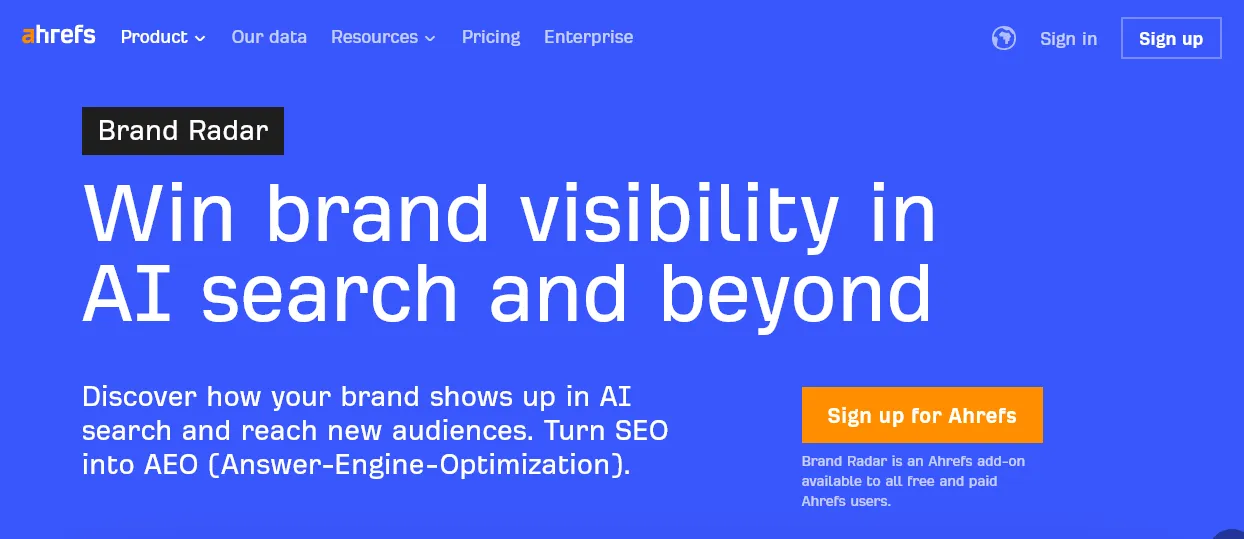
Brand Radar is Ahrefs' LLM visibility tool that tracks how brands appear in AI-generated answers across ChatGPT, Gemini, Perplexity, and Claude. Brand Radar tops this list for its database size: 110 billion keywords and over 150 million prompts, the largest AI visibility dataset available.
The monitoring resources are exhaustive, tracking metrics like AI Share of Voice, brand sentiment, and gap analysis. Content creators can use it by combining prompts by topic and identifying new opportunities. Brand Radar is also ideal for Ahrefs users, as it integrates flawlessly into the Ahrefs ecosystem and demands no learning curve.
Brand Radar is an Ahrefs add-on, which means users need an existing Ahrefs subscription in addition to the Brand Radar cost.
Pros:
- The largest AI visibility database
- Complete brand monitoring resources
- Ahrefs integration
- Perfect for tracking competitors
Cons:
- Requires an Ahrefs plan
- Costly add-on
2. Chosenly
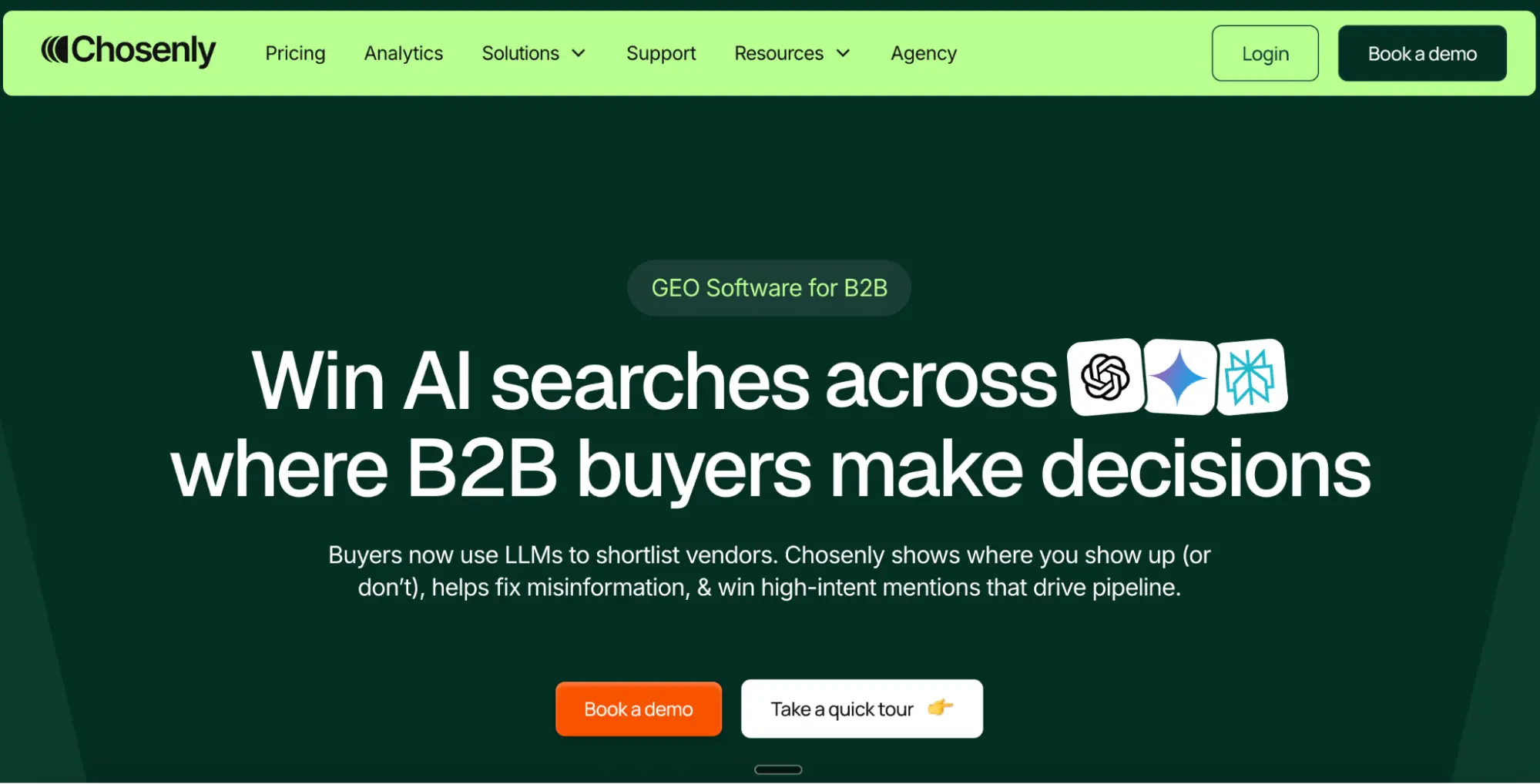
Chosenly is an AI SEO platform built specifically for B2B companies. Unlike tools that track a fixed list of prompts, Chosenly maps your entire industry from a seed keyword, identifying every purchase-intent search in your category and the criteria LLMs use to evaluate vendors. It covers the full workflow: visibility tracking, content drafting, listicle outreach, Reddit, and positioning, all inside one platform and reading from the same data.
Key Features:
- Seed Keyword to Full Industry Map: Add a seed keyword and Chosenly surfaces every relevant purchase-intent prompt in your category automatically, including the criteria LLMs use to choose one vendor over another.
- Competitive Visibility and Positioning: Tracks your visibility and rank against every competitor, broken down by topic and by buyer persona. The positioning module shows which company wins each criteria-persona combination and why.
- Content Drafting: When Chosenly identifies a content gap, it drafts the page or refreshes your existing page using top-cited sources, your brand guidelines, and your positioning.
- End-to-End Outreach: Identifies which listicles to target, prioritizes them by traffic and answer influence, finds the right contact, and runs the outreach.
- Reddit Automation: Finds relevant threads, groups them by action type, and drafts replies from your company information so they respect Reddit culture and accurately represent your brand.
Pros:
- Full-stack execution across content, outreach, and Reddit inside one platform
- Positioning module shows exactly which criteria to win and why
- Unlimited seats on every plan
- Dedicated Slack support and weekly GEO strategy calls included
Cons:
- Built exclusively for B2B, not suited for B2C or e-commerce
- Higher price point compared to monitoring-only tools
Reviews:
Chosenly has earned positive early user ratings. Teams have seen a 10x growth in their LLM visibility in five months and closed their first AI-sourced deal within eight weeks of launching.
3. Rankshift
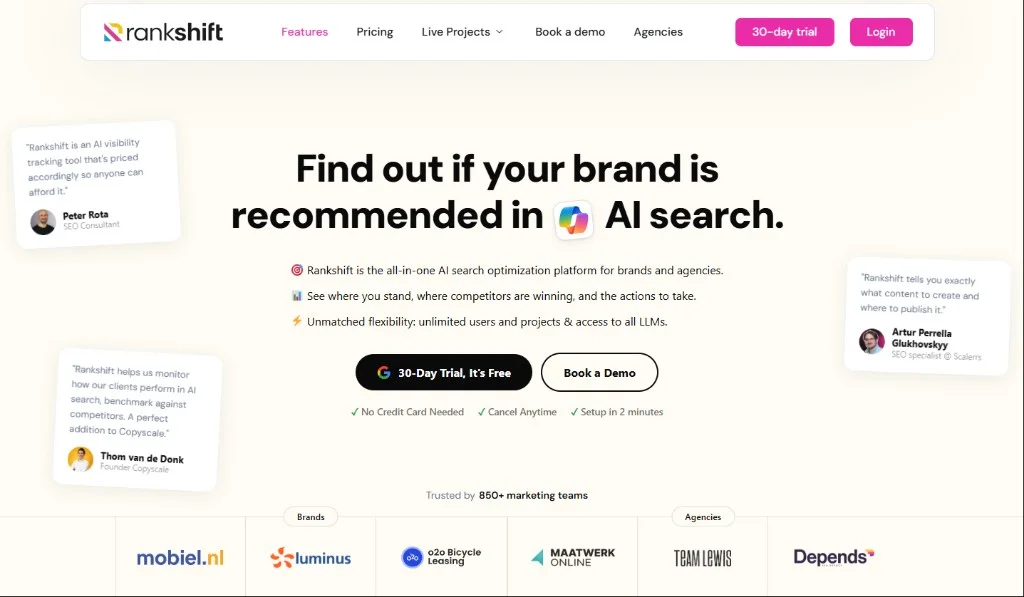
Rankshift is an LLM visibility tool that tracks how brands appear in AI-generated answers across ChatGPT, Gemini, Google AI Overviews, AI Mode, Copilot, Perplexity, Claude, Meta AI, and Mistral. Instead of traditional keyword rankings, Rankshift uses prompt-based monitoring and analyzes the actual AI responses to detect brand mentions, citations, and competitor presence.
Rankshift stands out for combining measurement with execution. Alongside share of voice and historical tracking, it runs sentiment analysis to show how AI models describe your brand, then feeds that into a built-in AI content writer that connects key concepts to relevant entities and drafts content designed to perform in answer engines. Its crawler analytics are another differentiator, showing when AI bots visit your site and which pages are actually used in AI-generated answers, a level of source-side visibility that most trackers based purely on model outputs cannot provide.
For teams that want the tool to sit inside their existing stack, Rankshift offers MCP integration (connecting to Claude, ChatGPT, Cursor, or n8n) plus reporting connections to Looker Studio, BigQuery, and Power BI. Every plan includes unlimited users and projects with unlimited geographic and language coverage, and pricing starts at €69/mo with a 30-day free trial and no credit card required.
Pros:
- Broadest engine coverage on this list (nine AI platforms, including Meta AI and Mistral)
- Built-in AI content writer, not monitoring only
- Crawler analytics show which pages AI bots actually use
- MCP integration plus Looker Studio, BigQuery, and Power BI connections
- Unlimited users, projects, countries, and languages on every plan
Cons:
- Credit-based pricing can be harder to predict at high-frequency tracking volumes
- Newer platform compared with established SEO suites
4. Semrush AIO
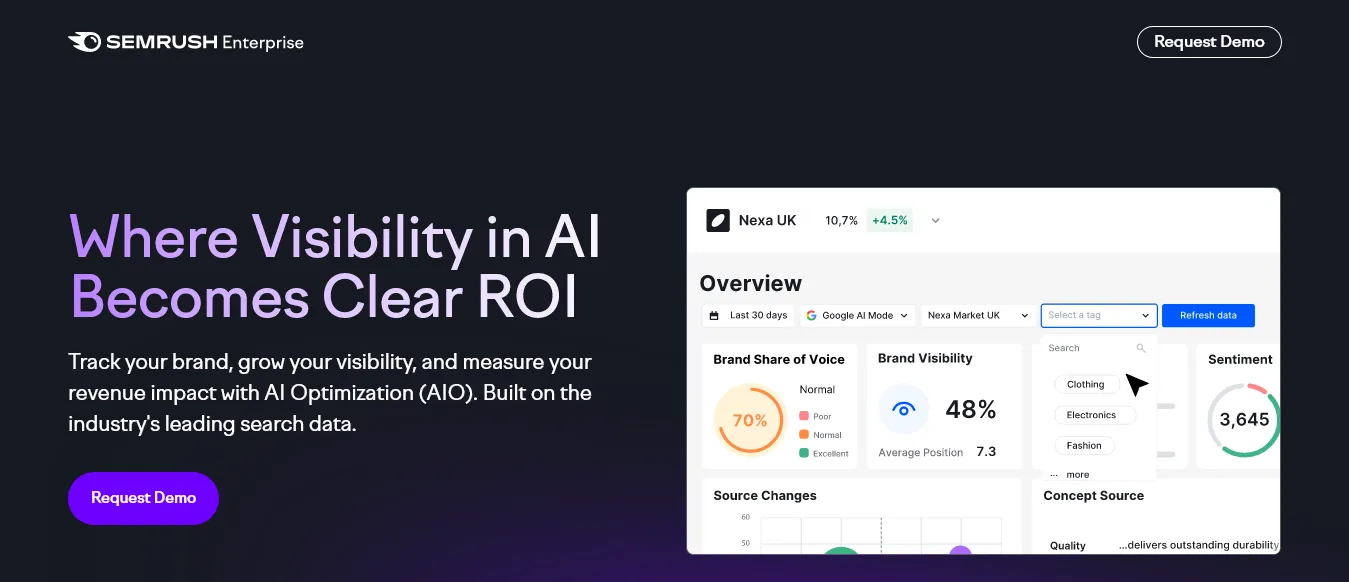
Semrush AIO is Semrush's enterprise AI optimization suite that goes beyond visibility tracking to include AI strategy, content optimization, and automated insights in a single dashboard. AIO is designed for large marketing teams with enterprise-level budgets.
The price, on request, should be too high for small budgets. However, Semrush AIO looks the part, covering metrics such as brand sentiment and keyword trends in one dashboard and delivering more than just LLM visibility - it's a complete suite for enterprises, covering everything from website optimization to content creation.
Semrush AI can also generate data-based insights, meaning it can act as an LLM visibility consultant for brands.
Pros:
- Strong option for enterprises
- Goes beyond LLM visibility
- AI visibility strategy with budget and reporting
- Impressive database
Cons:
- Not ideal for small budgets
- Still looks like a Beta product
5. Profound
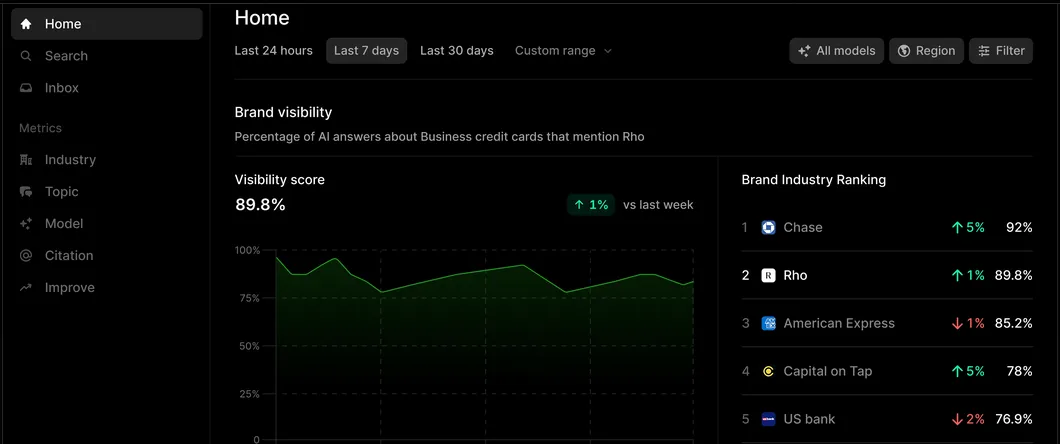
Profound is an LLM visibility tool focused on AI-driven product placement and conversion tracking. Profound's Shopping feature tracks where products appear in AI-generated answers and identifies the prompt patterns buyers use to discover products in each niche.
Profound can also target conversations related to your brand via prompt volumes based on keyword variations. In combination with the Shopping feature, this resource can be beneficial for fine-tuning content for AI engines, climbing the ChatGPT ranking, and outperforming competitors.
Despite offering affordable monthly plans for small companies, Profound is also an enterprise-first product, as the Starter package is limited to 50 prompts and exclusively covers ChatGPT.
Pros:
- Tracks product placement in AI
- Complete LLM visibility resources
- Workflows for optimizing content for AI
- Includes premium plans for agencies
Cons:
- The affordable packages have serious limitations
- No integration solutions
6. Peec AI
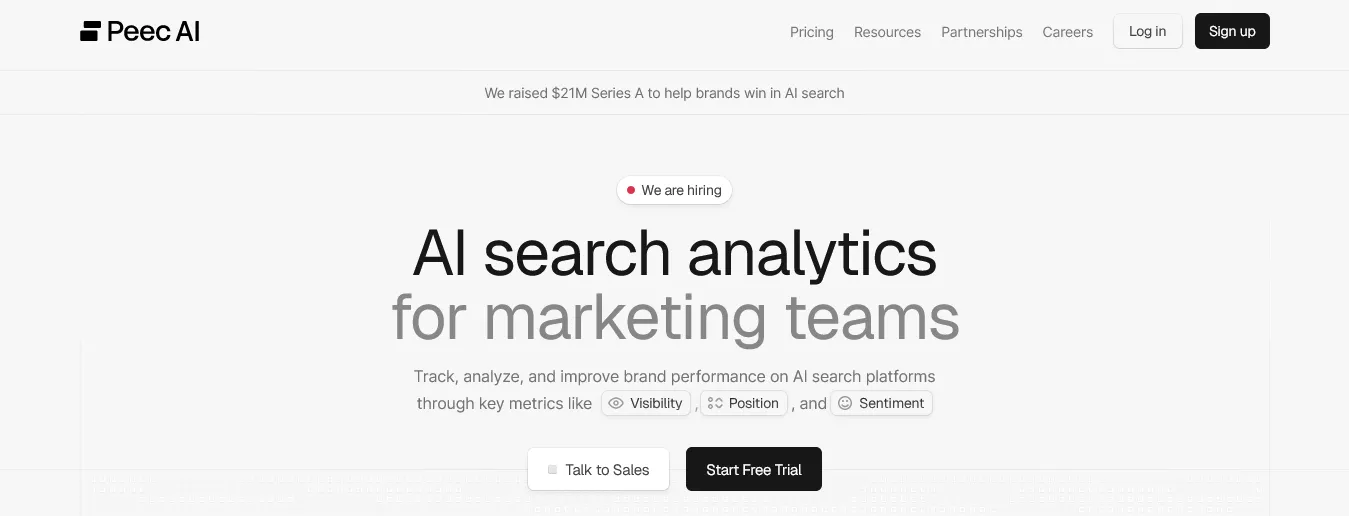
Peec AI is an LLM visibility tool designed for small companies, marketing teams, and freelancers who need affordable AI search monitoring. Peec AI tracks AI visibility, ranking position, and brand sentiment across ChatGPT, Gemini, and Perplexity, and lets users compare AI models side by side.
Despite being a nice tool for beginners, Peec AI tracks AI visibility, ranking position, and brand sentiment, covering all of the essentials. It's a top recommendation for mid-level projects, but scalability is possible, as Peec AI also has enterprise plans.
Peec AI only falls back to competitors for two reasons: it's still a relative newcomer with a reputation to build, and it discloses no info regarding the origin of its AI search database.
Pros:
- Accessible to small projects
- Beginner-friendly
- Designed for marketing teams
- Great for AI model comparison
Cons:
- No database information
- Not as established as some competitors
7. Surfer AI Tracker
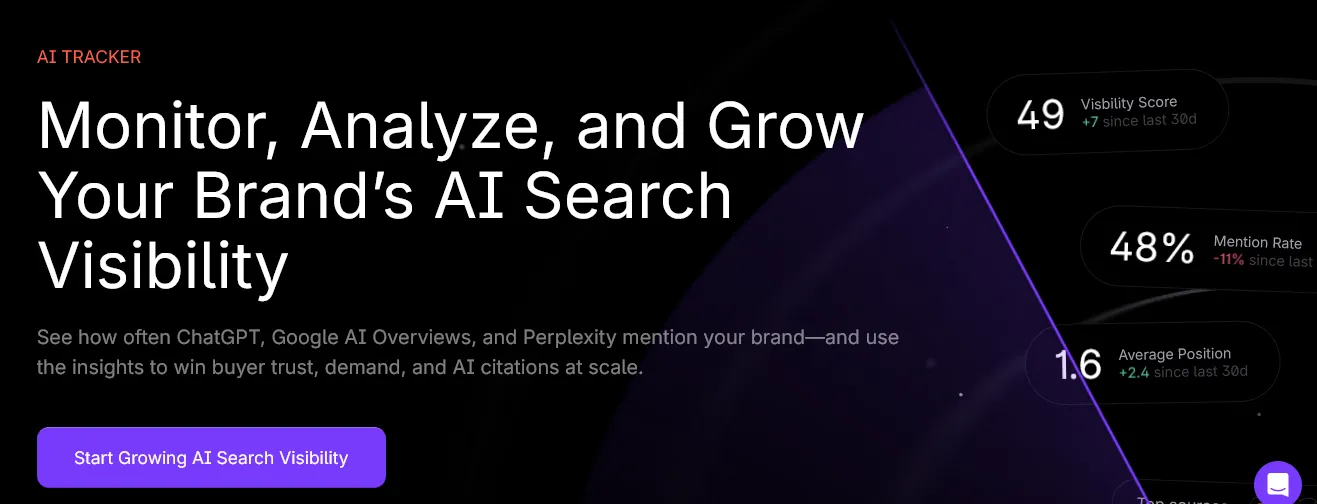
Surfer AI Tracker is Surfer SEO's add-on for LLM visibility, built for content creators who already use Surfer for SEO optimization. The AI Tracker monitors brand visibility across AI platforms and assigns a 0-to-100 visibility score for quick performance assessment.
You just need to enter a brand name, choose a topic, and select a location to identify popular related prompts and make the necessary adjustments to increase your chances of getting mentioned. Through its Insights feature, Surfer SEO gives brands a 0 to 100 visibility score - a useful, all-encompassing metric.
Some online reviews have classified Surfer AI Tracker's resource features as unreliable, but it remains one of the most solid options for content creators, especially if they're already Surfer subscribers.
Pros:
- Intuitive brand visibility dashboard
- AI visibility score
- Additional brand growth resources
- Ideal for Surfer SEO users
Cons:
- It's an add-on (requires a Surfer plan and an additional cost)
- Resource features can be unreliable
8. Rankscale
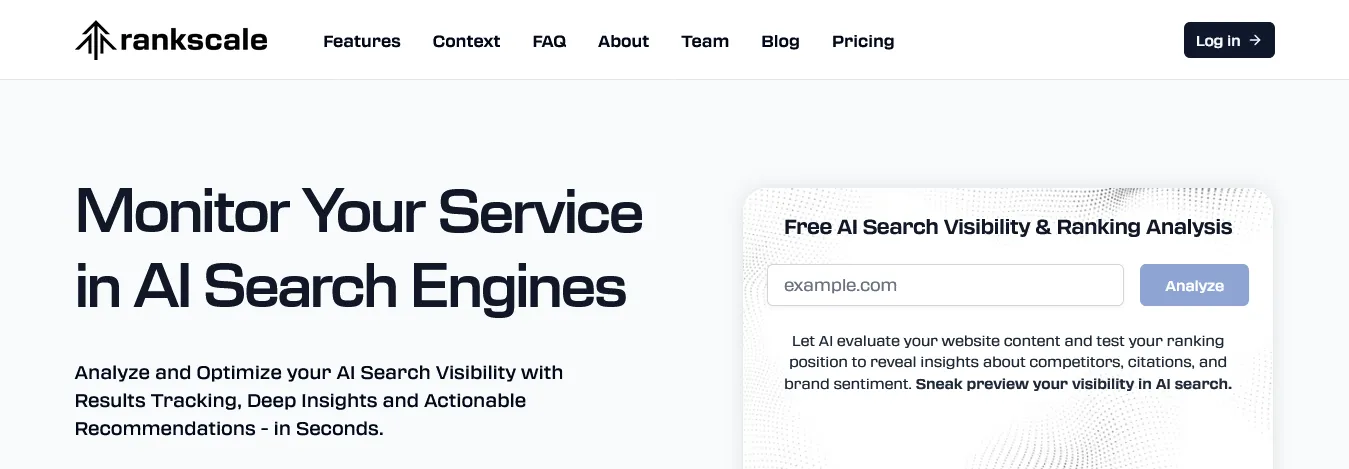
Rankscale is a Generative Engine Optimization (GEO) tracking platform built for scalability, with flexible plans that serve freelancers, startups, and enterprise teams from a single dashboard.
All action revolves around a "centralized GEO command center" where users can quickly access info regarding performance metrics, brand sentiment, and citation sources. They can also compare content to improve AI visibility, one of the tool's major advantages.
On the downside, expert reviews state that Rankscale cannot detect AI crawlers; its AI tracking is based on model outputs, which may not be as reliable as crawlers. This means Rankscale focuses more on AI citations and less on how AI models actually notice your content.
Pros:
- Highly scalable (from freelancers to enterprises)
- Side-by-side content comparison
- Citation & sentiment analysis
- AI readiness score (0-100)
Cons:
- Can't detect AI crawlers
- Premium plans use a credits system
9. Otterly.AI
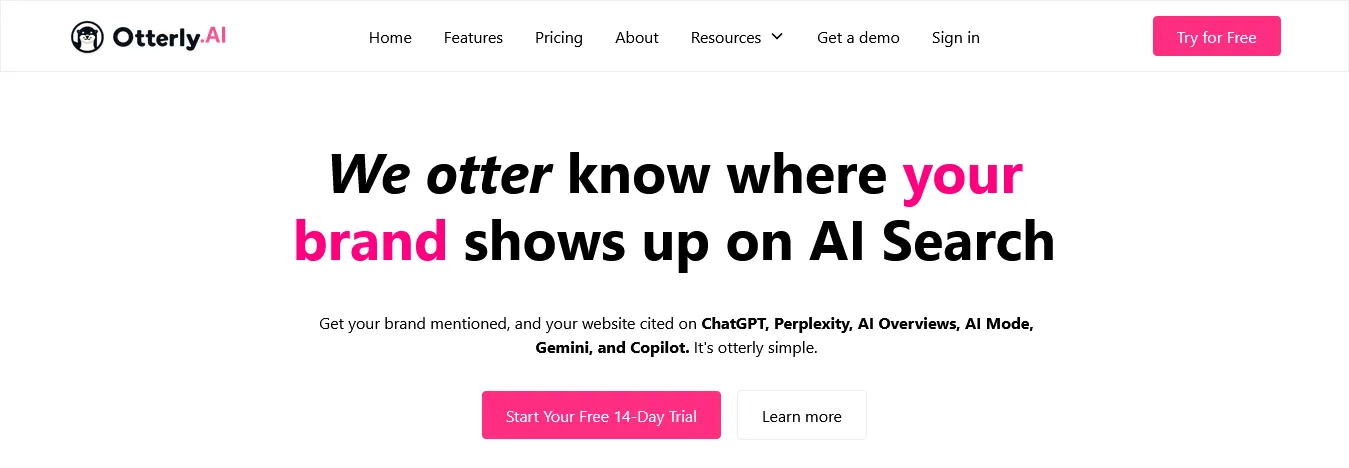
Otterly.AI is a budget-friendly LLM visibility tool that tracks brand position, sentiment, and citation sources across ChatGPT, Gemini, and Perplexity. Otterly reports that 95% of clients see measurable results after one month of monitoring. The platform covers all essential visibility features at a lower price point than Brand Radar or Semrush AIO.
Otterly users can turn keywords into prompts, see where their links come from, track brand position and sentiment, and receive weekly reports (automated, not customized). Clients can also access a GEO audit tool that identifies strengths and fixes weaknesses.
Ideal for beginner and mid-level freelancers, marketers, and small LLM visibility projects, Otterly doesn't offer the same level of depth and complexity delivered by the top-ranking tools in our list.
Pros:
- Extremely accessible (price- and usability-wise)
- Automated weekly reports
- Has all of the basic features
Cons:
- Limited when compared to top competitors
- No integration options
10. SE Ranking
SE Ranking is an SEO platform that includes a built-in AI search visibility module for tracking brand mentions in ChatGPT and Google AI Overviews. SE Ranking is best suited for teams that run SEO as their primary channel and want basic AI monitoring without switching platforms.
For this reason, SE Ranking is ideal for anyone who's still mainly focused on SEO but wants to access basic AI search metrics.
Pros:
- Good for light LLM visibility tasks
- Fair-priced premium plans
Cons:
- Only for tracking - no additional LLM visibility resources
- Mainly for SEO (GEO is an extra)
What Free LLM Visibility Tools Launched in 2026?
The ten tools above are paid platforms. In 2026, two free options arrived that every team should set up before deciding whether to pay for more.
Bing Webmaster Tools AI Performance. Microsoft launched this free reporting dashboard in public preview on February 10, 2026. It shows how your content is cited by Microsoft Copilot and, indirectly, ChatGPT, which retrieves through Bing's index, including page-level citation activity and the queries your content is used to answer. It is the first credible free way to measure AI citations, and it removes the budget barrier that gated measurement for most mid-market teams. It does not cover Gemini or Perplexity, which use different indexes, so it is a starting point rather than a complete stack. We cover setup in the Bing Webmaster Tools AI Performance guide.
GA4 AI Assistants channel. Google added an "AI Assistants" channel grouping to Google Analytics 4 on June 11, 2026. It automatically classifies sessions arriving from AI assistant referrals (medium ai-assistant) into their own channel, so you can see AI-referred traffic separately from organic search in a tool you already run. The caveats: it excludes Google's own AI Overviews and AI Mode (those still count as organic), and it is not retroactive, so the data starts accumulating from setup forward. It measures traffic, not citations, so it complements rather than replaces a citation tracker.
Together these mean any team can start measuring AI presence at zero cost: Bing AI Performance for citation activity, GA4 for AI-referred traffic. Add a paid tool from the list above when you need multi-engine citation tracking (Rankshift, Peec AI, Profound), competitor share-of-voice (Brand Radar, Semrush AIO), or full-stack B2B execution (Chosenly).
Which LLM Visibility Tools Should You Choose?
The right LLM visibility tool depends on your team size and goals:
- For ambitious, enterprise-level projects: Brand Radar, a super complete tool backed by Ahrefs' stellar reputation as an SEO market leader. Semrush AIO is a strong contender, but it still needs some development.
- For B2B full-stack AI search optimization: Chosenly, the only tool on this list that maps your entire category from a seed keyword and executes across content, outreach, and Reddit from the same data.
- For multi-model tracking with built-in content optimization: Rankshift, which covers nine AI platforms and pairs measurement with a built-in AI content writer and crawler analytics.
- For product-centric projects: Profound, one of the few tools that prioritizes brand placement tracking and AI-related conversions.
- For beginners and small teams: Peec AI, combining simplicity and affordability with a respectable set of visibility features.
- For scalability: Rankscale.
- For performing light LLM-related tasks in the context of SEO: SE Ranking.
If you need some outside help to improve your mentions on AI models, consider LLM performance improvement services or a dedicated GEO agency.
Frequently Asked Questions (FAQs)
What is the best free LLM visibility tool in 2026?
Two free options launched in 2026: Bing Webmaster Tools AI Performance (February 10, 2026) for Copilot and indirect ChatGPT citation data, and the GA4 AI Assistants channel (June 11, 2026) for AI-referred traffic. Used together they let any team measure AI presence at zero cost. Neither covers everything, so most teams add a paid tracker once foundations are in place.
What is the difference between a free tool and a paid LLM visibility tool?
Free tools (Bing AI Performance, GA4 AI Assistants) cover a narrow slice: Bing covers Copilot and indirect ChatGPT, GA4 covers AI-referred traffic but not citations. Paid tools (Peec AI, Profound, Brand Radar, Semrush AIO, Chosenly) track citations across multiple engines, competitor share of voice, sentiment, and source URLs in one dashboard. Start free, add paid when you need multi-engine depth.
Which LLM visibility tool is best for small teams?
For a paid tool, Peec AI is the most accessible, with plans aimed at small teams and freelancers covering ChatGPT, Gemini, and Perplexity. Before paying, set up the free Bing AI Performance dashboard and the GA4 AI Assistants channel, which together cover the basics at no cost.
Do LLM visibility tools track Google AI Overviews?
Some do and some do not, so check per tool. Note that the GA4 AI Assistants channel specifically excludes AI Overviews and AI Mode (Google counts those as organic search), so to measure AI Overviews presence you need a dedicated tracker that covers it rather than relying on GA4.
Can a tool alone improve my AI visibility?
No. A visibility tool measures where you stand and points at gaps, but it does not create content, build entity consistency, or earn the third-party citations AI models trust. You still need a team or an agency to act on what the tool surfaces. The tool turns blind effort into a directed program.