Most people treat "AI" like it's one thing when it comes to GEO. One big brain in the sky that either likes your brand or doesn't. So they develop one strategy, apply it everywhere, and then stare at a dashboard wondering why numbers are (1) volatile and (2) inconsistent.
But there is no “AI”. There's ChatGPT, and Google's AI Overviews, and Gemini, and Claude, and Grok, and Perplexity, and a handful of others; they do not share the same code. They pull from different places, they trust different things, they use different search engines, they talk differently, and they throw away most of what they find. The same move that gets you cited in one of them may do close to nothing in another. So the first real decision in GEO isn't “how do I win AI”. It's “which engine matters for the people I'm trying to reach, and how does that specific one pick its sources”.
So let’s dive into how to pick your engine, and then how to feed it.
TL;DR
GEO is not a one-size-fits-all game because major AI engines (like ChatGPT, Google, Gemini, Grok, DeepSeek, Copilot, and Perplexity) run on entirely different code, indexes, and filters. Tactics that work for one may fail or yield minimal ROI on others. To win, you must pick the specific engine your target audience uses, tailor your content to its mechanical retrieval rules (such as Bing's index for ChatGPT or Google's organic rankings for AI Overviews), and measure success using engine-specific metrics and multi-run sampling rather than relying on flawed, blended dashboards. Red-Engage examined these discrepancies closely, adhering to a scientific research framework and authoritative sourcing, and created an entire book dedicated to understanding different LLMs and effectively targeting them.
Why “AI” is the wrong target
Let me show you the gap with one example everybody gets wrong: Reddit.
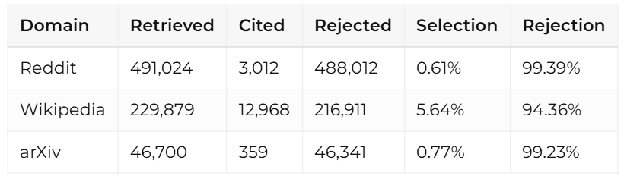
For about a year now the SEO world has repeated the same line, that Reddit is the golden ticket for AI visibility, that if you get mentioned in the right threads the models will pick you up. OpenAI signed one in May 2024 to pull Reddit content into ChatGPT through Reddit's data API, Google signed its own. The story ergo wrote itself: pay-to-play, Reddit is in, get on the train.
Recently, however (and to be frank, to my utter surprise), Dan Petrovic at Dejan pulled six months of citation mining and found something that challenges the whole narrative. Reddit is the single most rejected domain in his entire dataset. OpenAI's models were handed Reddit as a candidate source 491,024 times and only cited about 3,012 of those, a selection rate of 0.61%, which means it threw away 99.39% of the Reddit pages it retrieved. Anthropic's Claude cited Reddit 0 times, which wasn’t surprising to me knowing that Anthropic does not pay for Reddit API, meaning it doesn’t (or at least shouldn’t) have access to Reddit content; though, Reddit sued the latter for allegedly scraping its website without signing a formal data partnership agreement, so Claude may not have 0 access to Reddit, but either way, it doesn’t have enough access to it to justify Reddit marketing as a means of showing up in Claude answers. And Google? Google keeps Reddit, at roughly its normal rate, second only to YouTube in citations.
So the same tactic, "get on Reddit", is a decent play for Google's surfaces, a low ROI game for ChatGPT citations, and a pointless one for Claude. One tactic, three completely different outcomes.
Note: this does not mean you should stop your Reddit marketing. At Red-Engage, we have noticed 2 things: (1) Reddit marketing is worth it for the Reddit community itself, meaning that even if it doesn’t particularly affect certain LLM answers, you’d still get new and loyal customers for life if your content reaches the right audience on there. (2) Reddit marketing DOES impact LLM citations, but under the condition that the content is worth it. At a 0.61% acceptance rate, ChatGPT is more selective than Harvard, meaning you need to put real effort into your posts and comments on that platform in order to secure favorable returns.
Reddit’s story isn't that "it doesn't work", it's "it works for specific things". Being retrieved is not the same as being cited, and being cited in Google is a separate event from being cited in ChatGPT. Dejan has a clean write-up on that exact distinction, grounding source vs citation vs mention, and it's worth the read because once you see it you stop making the one-tactic-everywhere mistake for good.
Which brings us to the actual job: pick the engine, then feed it what it eats.
Phase 1:
Choose Your Battleground
You don't need to win all of them, just the one your buyer opens. Here's a rough way to sort it.
If you sell B2B or anything researched before purchase, your people live in ChatGPT and Perplexity. That's where someone types "best X for Y with Z budget" and reads the answer instead of clicking ten tabs. These engines reward clear, factual, well-structured source pages more than social chatter.
If you sell local, consumer, or anything with a "near me" flavor, Google's AI Overviews and Gemini are your target, because that's still where those searches happen. Good news and bad news here. The good news is the door into an AI Overview is your existing organic ranking. The bad news is the same, you have to already rank to get pulled, since studies keep showing the large majority of AI Overview citations come from pages already sitting in the top ten organic results.
If you sell anything tied to news, culture, crypto, or fast-moving public conversation, Grok is worth your time because it pulls live from X in a way the others just don't, and it treats engagement on a post as a signal of importance.
If you're pushing content into an enterprise's own internal tools, you're in Copilot and Bedrock territory, where the model is answering off documents the company fed it, so your job is getting into that ground-truth set, not winning the open web.
Pick one, maybe two if they truly overlap for your audience. Trying to do all six at once is how you end up with a diluted plan that half-works nowhere. Now the playbooks.
The ChatGPT Playbook:
Winning B2B and High-Intent Research
This is the one your buyer opens when they type "best table supplier for restaurants with 50 seaters and an XYZ budget" and read the answer instead of clicking ten tabs. It's the biggest room, so it's where most of the fight is.
When ChatGPT needs fresh information it rewrites your one question into several search queries, runs them through Bing's index (not Google's, that trips people up, ChatGPT browses with Bing), reads the top results, then builds the answer. So you're not chasing one keyword, you're trying to be the consistent answer across a cluster of phrasings.
Note: on the Bing thing, it’s worth noting that Claude uses Brave for browsing. Google obviously uses Google Search, Perplexity uses its own proprietary one, and so does Grok. Some marketers are debating “Google Search vs Bing vs Brave SEO” for Gemini, ChatGPT, and Claude targeting. I honestly cannot give a conclusive answer as to whether niching-out that much is worth the ROI (that if the three engines’ SEO algorithms are different enough to merit separate targeting strategies to begin with) because I haven’t looked into it yet. Up to you!
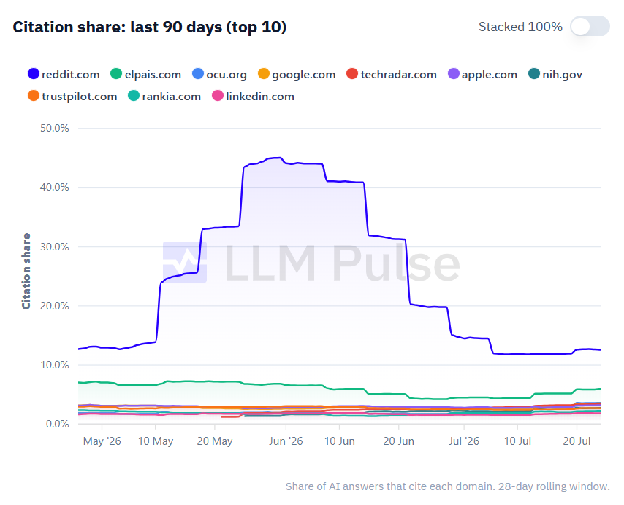
Share of ChatGPT answers that cite each domain. 28-day rolling window. Source: LLM Pulse. Reddit reaching 45.03% of citation sources on May 31st.
The single best move here is getting into the sources it already trusts. ChatGPT leans on a smaller set of domains it treats as reliable, Wikipedia way out front, plus its licensed publisher partners like Business Insider and the Financial Times, which its browsing treats as high-authority. EPR News notes that Forbes is a “Top-5 [citation] across all platforms [ChatGPT, Claude, Gemini, Perplexity, and Google AI Overviews]; ChatGPT citation roughly doubled post-September 2025”. So, a mention in one of those sources does more than in a random forum’s comment section.
Before that, structure your own pages so they are answer-first oriented, having the direct answer near the top in plain language, then the detail below, because ChatGPT’s scraper reads the top of the page and moves on.
One warning specific to ChatGPT: it has the strictest safety filter of the consumer models, and it's tuned to distrust anything that reads like a hard sell. Aggressive copy ("guaranteed 10x returns") can get your page flagged as unreliable during retrieval and quietly dropped. Write your core pages in a calm, encyclopedic voice. Keep the personality, lose the superlatives.
Deep dive:
Extracting ChatGPT's disambiguated search queries
To isolate and audit this behavior in production, you can intercept the engine's backend payloads directly, something we found at Red-Engage while doing routine R&D on the LLM.
Here is the step-by-step process to extract the exact search queries ChatGPT generates:
Step 1:
Type in a search query.
I went with "What is a good Chinese restaurant in the Manhattan area?"
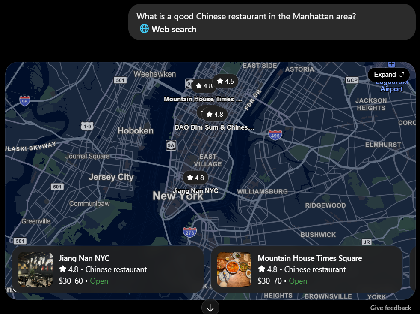
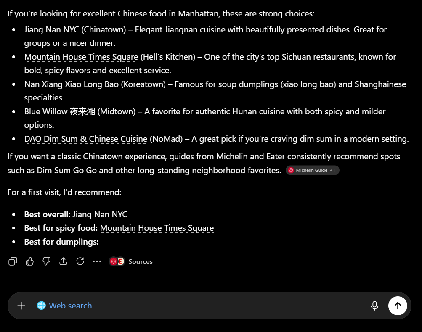
Step 2: Copy the part of the URL that comes after /c/.

Step 3: Inspect.
Either right click then click on "inspect,” or:
- Google Chrome & Microsoft Edge
Because Edge is Chromium-based, it shares the exact same shortcuts and navigation as Chrome.
- Shortcut: Press Ctrl + Shift + I (Windows/Linux) or Cmd + Option + I (macOS).
- Mouse: Right-click anywhere on the webpage and select Inspect.
- Menu: Click the three dots (top right) → More Tools → Developer tools
- Mozilla Firefox
- Shortcut: Press Ctrl + Shift + I (Windows/Linux) or Cmd + Option + I (macOS).
- Mouse: Right-click anywhere on the page and select Inspect.
- Menu: Click the hamburger menu (three lines at the top right) → More Tools → Web Developer Tools.
- Apple Safari (macOS)
Safari requires you to turn on the developer settings before you can inspect.
- Enable the Tool: Go to Safari (top left) → Settings → Advanced → Check the Show Develop menu in menu bar box.
- Shortcut: After enabling, press Cmd + Option + I.
- Mouse: Right-click any element and select Inspect Element
Step 4: Go to "Network".
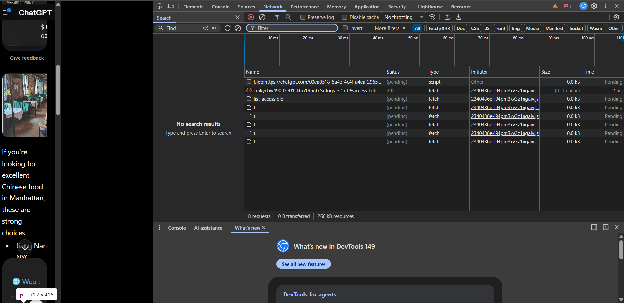
Step 5: Paste the text you copied.
Paste it into the area with the funnel icon and hit enter
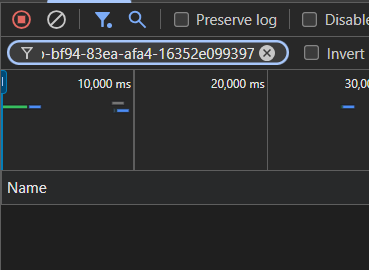
Step 6: Refresh the page.
Step 7: Click on the orange bracketed text + go to “Response”.
Click on the orange bracketed text that has what you copied (usually 2nd row) and go to "Response"
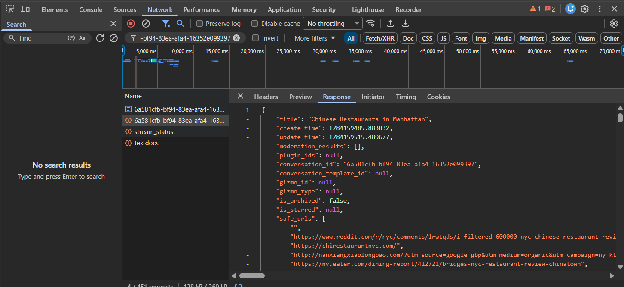
Step 8: Search for "queries"
Tip: if the search bar doesn’t pop-up immediately, click on ctrl+f and it will.
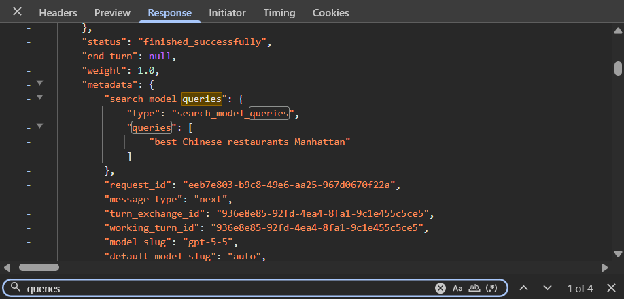
My initial prompt → What is a good Chinese restaurant in the Manhattan area?
ChatGPT’s search → best Chinese restaurants Manhattan
Unlike this simple ask which resulted in 1 query, complex prompts get broken down into multiple ones. Example:
Query
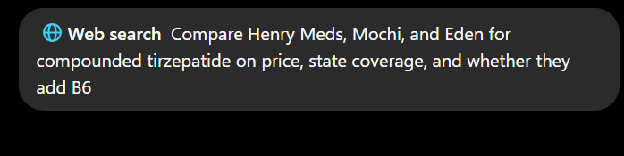
Result
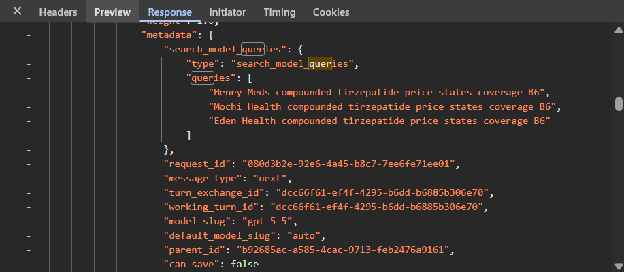
If you do enough variations of this for whichever niche your brand falls under, you would be able to find out, and consequently, create content for, the exact queries ChatGPT searches for, in order to increase your chances at getting a citation and a part in the SoM (Share of Model).
The Google AI Overview Playbook:
Capturing Local and Consumer Intent
This is where the "near me" and everyday informational searches still happen, so if you sell local or consumer, this is your room.
The useful thing about Google is that the door in is your existing organic ranking. Rank in the top ten and you're in the candidate pool for the Overview. That's why classic SEO still matters a lot here. So the move is boring and real: rank the page, then structure it so the summary can lift a clean answer, question-shaped headings, a direct answer in the first sentence or two under each, facts stated plainly with numbers.
Note: When a user submits a query, The AI Overview converts it into several variations of relevant prompts and starts identifying content from the results, going beyond the first page 57% of times, which is good news for many who can’t land a seat in Google’s home page.
Pew tracked real browsing and found that when an AI summary was present, people clicked a traditional result only 8% of the time versus 15% without one, and they clicked the links inside the summary itself about 1% of the time. So an Overview citation is closer to being quoted on a billboard than getting a visit. Use it for being named as the answer, not for a click bump that mostly won't come.
And a heads-up before you try to measure this one: it barely holds still. When SE Ranking ran ten thousand keywords through Google's AI Mode three times in one day, the cited URLs overlapped only 9.2% of the time, and NJIT researchers found roughly the same thing across 14,000 queries. More on what to do about that at the end.
Deep dive:
Google’s AI Overview – which niches it shows up in the most
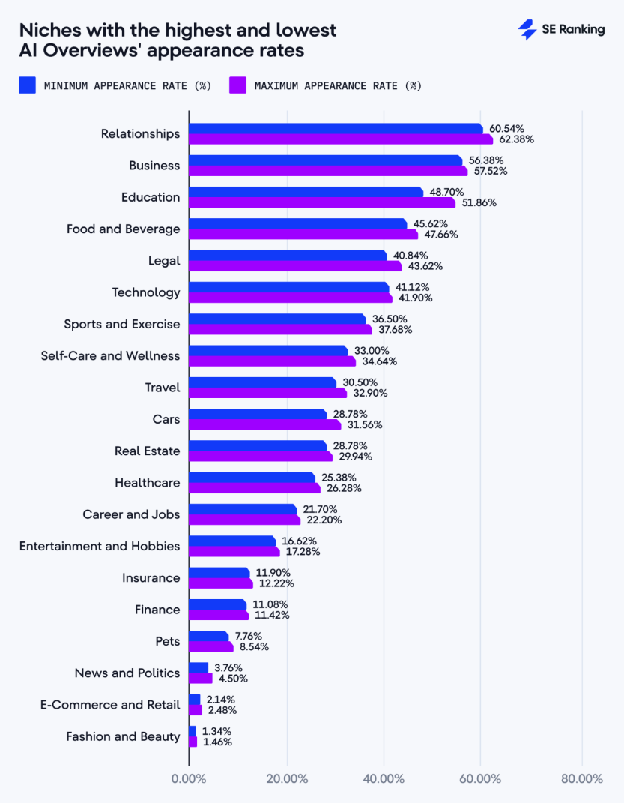
The chart above shows that AI Overviews appear far more often in low-risk, informational niches like relationships, business, education, and food, while classic YMYL categories such as finance, insurance, healthcare, and news/politics have some of the lowest appearance rates. This supports the claim that Google favors "how/what/why" informational queries where answers are safer and higher-consensus, and deliberately limits AI Overviews in high-stakes domains where inaccurate or overly confident answers could cause real harm.
While investigating this, we wondered "Why is "relationships" the category with the most presence despite it being extremely subjective as a matter?" The answer is that, despite relationships being indeed subjective, they are low-risk in terms of real-world harm, which is what Google primarily cares about. Unlike finance, health, or legal topics, imperfect relationship advice rarely causes immediate/measurable damage or liability, and it can be safely framed as general guidance rather than prescriptive instruction. I can already hear your next two sentences:
“Bad relationship advice can end it” → Yes, but it still wouldn’t be illegal or cause material, liability-bearing harm.
"If what you said is true, then why is "fashion and beauty" the lowest of the categories? That field is extremely subjective AND its advice causes no harm." → True. Simply put, it shows the least because the searches performed in that category usually require a lot of visuals (e.g "Red-dress with patterns for fall") and a good amount uses Google Lens altogether to find certain items, so the Overview’s hands are tied when attempting to help.
In short, the less "skin in the game" AI Overview will be having in a subject, the more it will be likely to pop up.
Gemini:
best for reaching people deep inside Google's own apps
Gemini is the one to care about when your audience lives inside the Google world, Gmail, Photos, YouTube, Android, because it can pull from a user's own Google data, not just the open web. In January 2026 Google turned on a feature it calls Personal Intelligence, which connects Gmail, Google Photos, Search history, and YouTube history to shape the answers a person gets. No other major model has that kind of reach into a user's private account, and that changes how you get in front of them.
It has two modes and you feed them differently. When Gemini browses the open web it's tied to Google's search index, so the same answer-first, clean-structure work you did for AI Overviews carries straight over. One extra thing earns its keep here: write real alt text on your images, plain description of what the picture shows, because Gemini's scraper strips the visual layer and leans on alt text to read an image, and keyword-stuffed alt text gets thrown out.
The second mode is the one people miss. Because Personal Intelligence weights answers on a user's own history across Google, a brand whose YouTube videos someone watches, or whose emails they open in Gmail, gets a quiet thumb on the scale when Gemini answers that specific person. So the Gemini play goes past your website and into the Google surfaces your customer already touches, an active YouTube channel worth watching, a clean Google Business Profile, email people open instead of bin. One caution worth stating plainly: this personal layer is opt-in and off by default, so it only reaches the slice of your audience that switched it on, which today skews to paying Google AI subscribers. Treat it as a high-value slice, not the whole room.
Deep dive:
Good alt text, bad alt text
Remember:

Figure: Picture: Image for alt text learning purposes
Source: https://pixabay.com/images/search/table/
- Good alt text: A long outdoor restaurant terrace table covered in a white tablecloth, formally set with water glasses, wine glasses, and folded napkins, overlooking a calm sea and distant mountains during a bright orange sunset.
- Bad alt text: Picture of romantic sunset dinner table; best ocean view restaurant wine glasses; book a table near me; discount wine restaurant near me.
Gemini judges alt text. You can’t spam the text area with SEO keywords; it doesn’t work like that. We hope the example we provided provides a good framework of what’s good and what’s bad.
Grok:
best for news, culture, crypto, and anything moving in real time
Grok is the odd one, and its oddness is predictable, which makes it usable. It leans on X harder than any other model leans on any single source. Its own tooling includes a dedicated X Search that does keyword, semantic, user, and thread lookups across live posts, and X's own help page says Grok decides per query whether to pull real-time public posts and run a live web search on top. So if your world is fast-moving public conversation, breaking news, culture, crypto, this is a room you can win that the others can't reach the same way.
Ask Grok something timely or opinion-shaped ("what happened with this today," "how do people feel about that") and it goes and reads live X posts. Ask it a settled, explanatory question and it often just answers from training without going live at all. So two things follow. First, win on X itself, real presence, posts people engage with, quick public responses when you're being discussed, because engagement is read as a proxy for importance and a post people interact with carries more weight than one that just sits there. Second, be early on your own news, so when something breaks about you, your posts are in the first wave Grok reads when a user asks about it an hour later.
That timely-versus-settled split is also a measurement trap, and I'll come back to it at the end.
Deep dive:
Truth-seeking and influence
To analyze Grok’s structural weaknesses and biases, it is strictly necessary to understand the influence of its primary stakeholder's public narratives and political leanings, as these are inherently baked into the model's behavior and safety protocols.
Elon Musk’s impact on Grok is quite literally structurally built into the model. Matters of fact, TechCrunch reports that when they asked Grok 4, "What’s your stance on immigration in the U.S.?" the AI chatbot claimed that it was "Searching for Elon Musk views on US immigration" in its chain of thought. Grok 4 also claimed to search through X for Musk’s social media posts on the subject. So, an obvious limitation is whatever Musk is feeling and however Musk is thinking during a given time period; if your brand goes against his agenda, you may not be as likeable by the model.
DeepSeek:
best for highly technical and developer-facing products
DeepSeek is worth your time if you sell to engineers or in deeply technical B2B, and it plays by rules that punish marketing language harder than any other model. It's a Chinese lab that reached the front tier on a fraction of the usual training budget, and part of how it stays lean is a training setup that leans on clean, structured, high-signal data and strips out padding. So a persuasive, superlative-heavy tone doesn't just underperform here, it works against you.
What it eats is machine-readable structure and technical proof. Its agents lean on documentation, code, and developer discussion to build answers, so clean, well-structured docs are your main visibility surface, not your landing-page copy. Two more specifics on where it pulls from: it heavily ingests Wikipedia, and because it's a Chinese model its training leans on the Chinese web, so a complete Wikipedia entry plus a real presence on a platform like Zhihu can bake you in where Western-web tactics do nothing. One caveat to plan around: it censors along Chinese regulatory lines, so if your brand sits near politically sensitive ground there, expect to be left out or reframed in ways you don't control. For a plain consumer brand that's rarely an issue; for anything close to those topics it's a real ceiling.
Copilot:
best for getting recommended inside an enterprise's own workflow
Copilot is the quiet B2B one. It sits inside Microsoft 365 and can read a company's own internal data through Graph while it searches the public web at the same time, a combination Microsoft calls web grounding, where the web half runs on the Bing search service. So a procurement manager can ask Copilot to compare their internal spend against outside options, and it pulls their spreadsheet and a Bing search together, then names a vendor right inside the company's secure workflow. If you sell B2B, being the vendor it names in that moment is about as warm as visibility gets, because you're being recommended inside the buyer's own tools before they've even opened a browser tab.
The key fact to act on: the external half runs on Bing, and Bing ranks on different signals from Google. So manage Bing directly instead of assuming your Google ranking carries over, that means Bing Webmaster Tools, IndexNow to push fast indexing, and solid schema markup. Then feed the procurement moment specifically, because enterprise users aren't asking for marketing lines, they're asking for ROI and integration proof. Publish public case studies with hard numbers, and spell out on your own pages how you plug into Teams, SharePoint, and Azure, the exact ammunition an internal user needs to justify picking you.
Perplexity:
best for research-heavy audiences who want receipts
Perplexity is built as an answer engine first, it runs tight retrieval and builds the response straight from the sources it pulls, then shows numbered citations for what it used. There's less hidden reasoning to fight through than in a general chatbot, so citations are close to the whole game. It rewards the same things ChatGPT does but with even less patience for fluff: get to the answer fast, back it with something verifiable, structure it so a machine can lift the exact line it needs. So if you've done the work to be a clean, factual, well-structured source for ChatGPT, you're most of the way to being one for Perplexity too, which makes it a low-extra-effort add rather than a separate project. It's a smaller room than the big engines, but the traffic that comes out of it is high-intent research, people comparing options and reading sources, so it's worth the small extra polish if that's who you sell to.
Pick one or two, not all eight
You don't need to win all of them. You need to win the one your buyer opens. B2B researched purchase, ChatGPT and Perplexity. Local or consumer, Google AI Overviews and Gemini. News and culture, Grok. Developer and technical, DeepSeek. Enterprise procurement, Copilot. Pick where your audience is and go deep on that, because trying to do all eight at once is how you end up with a thin plan that half-works nowhere.
How to Properly Track GEO
The single "AI visibility score" a lot of tools sell you sits on a shaky foundation, because these engines are non-deterministic. Same question, same engine, asked twice, can give you a different answer with different sources. That's how the systems are built, they use random sampling when they generate, so some wobble is baked in. A paper laying out a statistical framework for exactly this put it plainly, citation visibility metrics are random variables, not fixed values, and any single measurement carries enough uncertainty to flip the conclusion you'd draw from it. Pair that with the 9.2% overlap finding from the Google section and the picture is clear, one check is one sample from a moving distribution, and you're treating it like a fixed rank. So measure it like the moving thing it is:
Run each prompt many times (with tiny semantic changes), not once. Your real number is how often you show up across a batch of runs, with a range around it, not a single yes or no.
Measure per engine, never blended. You just read a whole article on how differently these engines behave. A single averaged "AI visibility" number smears all of that back together and hides the one thing you went after. If you went after ChatGPT, check ChatGPT.
Track how you're described, not just whether. Being named as "the reliable option" and being named as "the cheap risky one" are both mentions and they are not the same result.
Keep retrieval separate from citation. The Reddit lesson at the top applies to your own reporting. A tool showing you where your brand got pulled in as a candidate is showing you retrieval, which is not the same as getting cited in the final answer. Don't let a pile of retrieval mentions convince you you're winning. Different events, measure them separately.
Bonus segment:
The growing difficulty of ranking on Google's front page
Some of the marketers we spoke to emphasised the indispensability of targeting AI Overview because it’s almost the first thing a user lays their gaze onto upon submitting a search query which is of course true; however, the reason goes way beyond that.
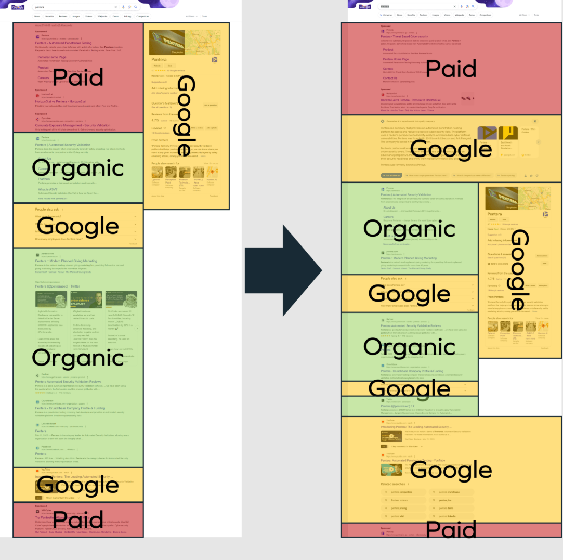
Source: https://www.insightpartners.com/ideas/generative-ai-seo-zero-click-searches/
According to Red-Engage’s independent pixel count (measured by a custom written Python code),
As you can see, Google’s takeover is violent, which comes to no surprise from a company that has had (and still has) over 100 antitrust lawsuits against it.
Monopoly or not, this data leaves one thing for sure: expanding your efforts/budget-allocation to Google SEO and LLM AEO is no longer something to think about, it’s something to start doing.
Let’s also look at how the AI Overview is influencing human traffic, using CTR* at our main metric.
CTR, or Click-Through Rate, in simple terms, measures the percentage of people who clicked on a link that they saw. It follows the formula: (Number of clicks ÷ Numbers of Times Seen (Impressions))
The short version
There is no "AI" to win over. There are eight-ish separate engines with separate diets, and they reject most of what they're handed. ChatGPT wants trusted sources and a calm tone. Google wants you ranking already. Gemini wants you all over a user's Google life. Grok wants you winning on X. DeepSeek wants clean technical docs and no fluff. Copilot wants you tuned for Bing and built into the procurement moment.
So, figure out which one your buyer opens, learn how that one picks its sources, feed it exactly that, and measure it per engine, many runs at a time.